A financial advisory firm.
Now, run through an intelligence layer.
How NorthBound Advisory, a 90-person Indian professional services firm embedded AI across their tax, due diligence, and CFO services. Synth — an AI assistant built by BaseThesis Labs — deployed across the firm and what it concretely took to make it real.

°Measured against North Bound's prior manual baseline across comparable engagements, 2025–2026.
90 people. 200+ clients. A regulatory stack that never holds still.
Founded in 2017 in Bengaluru, NorthBound Advisory (previously Kayess Square Consulting) offers fractional CFO, tax, valuation, and due-diligence services. In 2025: ₹10 Cr pre-Series A raised, and the tax division of Consark Advisory Services LLP acquired.
- Productivity Floor
- The consequence North Bound is living: manual work caps how fast they can turn around deliverables, which caps the number of clients they can serve without adding headcount.
- Task Fit
- The opportunity cost: the specific work that's eating their team's time is exactly the work that has been empirically shown to be automatable.
- Indian Regulatory Complexity
- The risk of generic solutions: if North Bound tries to solve this with off-the-shelf AI, they will fail because Indian compliance specificity is challenging.
- The strategic constraint
- The bottleneck on growth isn't hours anymore, it's the number of senior relationships partners can hold — and that's invisible when the team is buried in execution.
The tool stack
Every system above stays in place — Synth layers onto it rather than replacing it, syncing data back so nothing disrupts the existing workflow.
484 hours in 1 month by ~20 employees in just accounting entries across their clients. Why does it really take so many hours passing accounting entries?
In weeks when CAs and finance executives need to close on time, passing accounting entries and managing the books takes up a disproportionate amount of time — and accounts for most of the work. It's not just one task. It could comprise of:
- 1Receiving source documents from clients (invoices, bills, receipts, bank statements, expense claims) — often late and incomplete, either in a OneDrive, or email
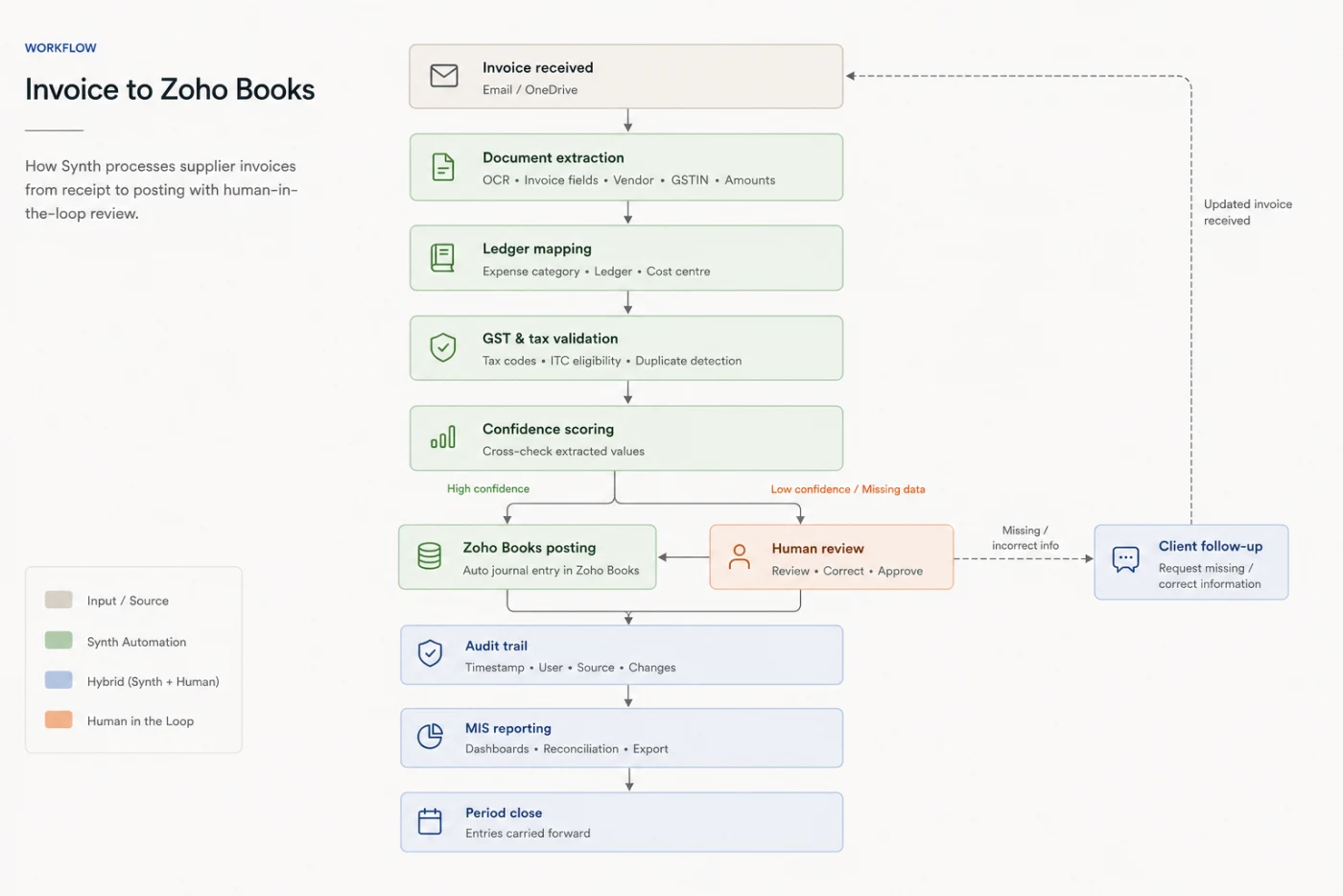
- 2Reading and interpreting each document to extract: date, amount, party name, nature of transaction, GST treatment, TDS applicability
- 3Determining the correct ledger mapping — which account head this goes to in Tally/Zoho
- 4Actually doing the entry into Tally or Zoho
- 5Handling exceptions — missing info, unclear categorization, duplicate entries, mismatch between bank statement and invoices
The reason it takes so much time is not that step 4 is hard. It's that steps 1–3 and 5 are very manual, require judgment, and depend on client responsiveness. The entry itself may take less time but getting the information to make that entry takes immense time and effort. It's ultimately to have books ready for GST filing (by 11th/13th of following month), TDS filing (by 7th), and monthly close / MIS or many other things. But it piles up at month-end because clients also send 100's of documents late and NorthBound has to scramble.
What Synth does inside NorthBound
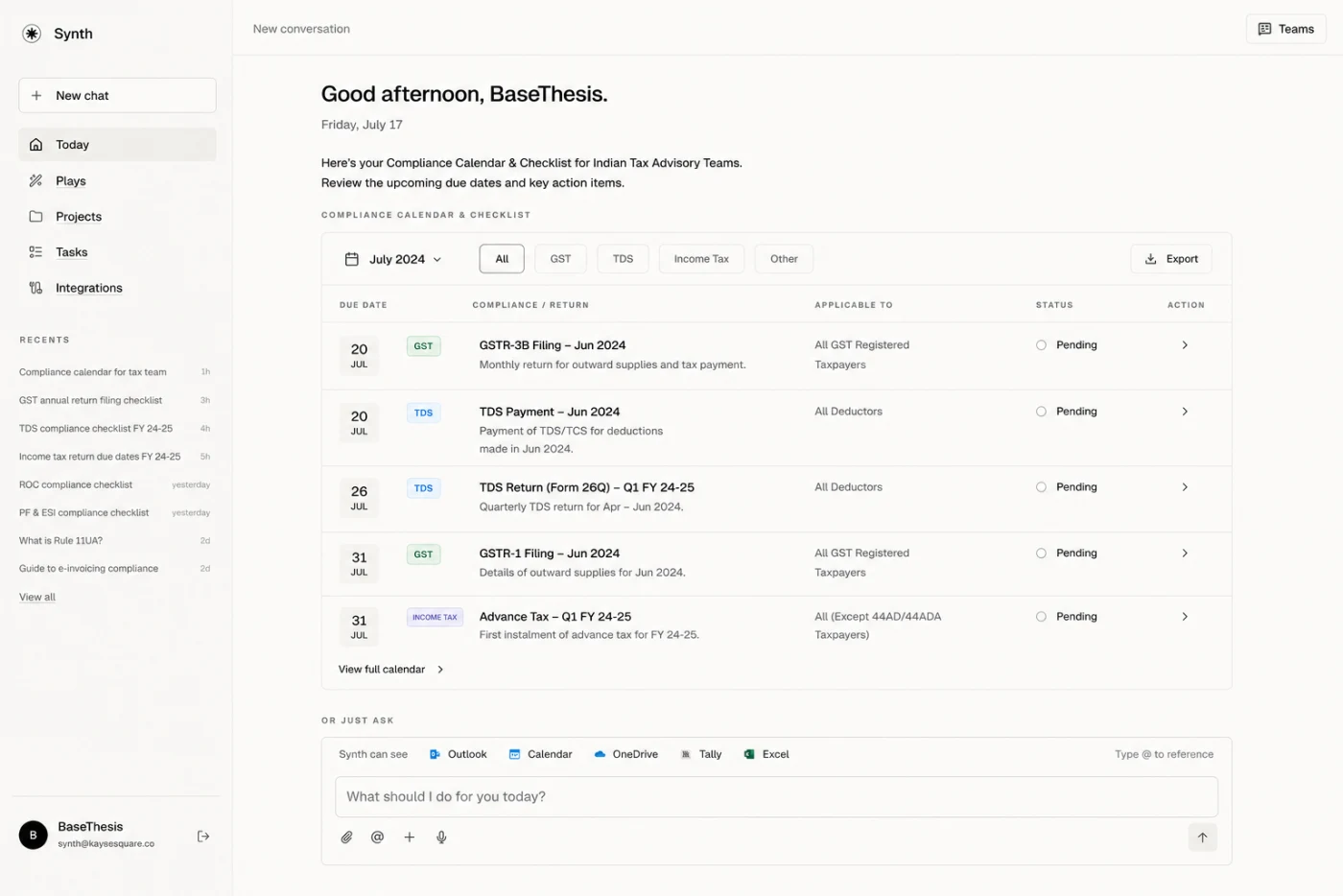
Three properties distinguish Synth from a generic LLM deployment in financial services:
- i.System and tool integrated — Synth connects to Tally Prime, Zoho Books, Microsoft 365 (Outlook, OneDrive, SharePoint, Teams), and Google Drive. Analysts work where they always have; Synth is the connective layer.
- ii.Financial-sector intelligence — built-in understanding of Indian accounting standards and statutory formats. Schedule III, AS-3, GSTR-2B reconciliation logic, TDS section mapping — modeled explicitly, not inferred.
- iii.Context memory, multi-model architecture and company-level understanding — Synth retains the chart of accounts structure, client entity setup, and IRL templates across sessions. A new monthly reconciliation run does not re-map from scratch.
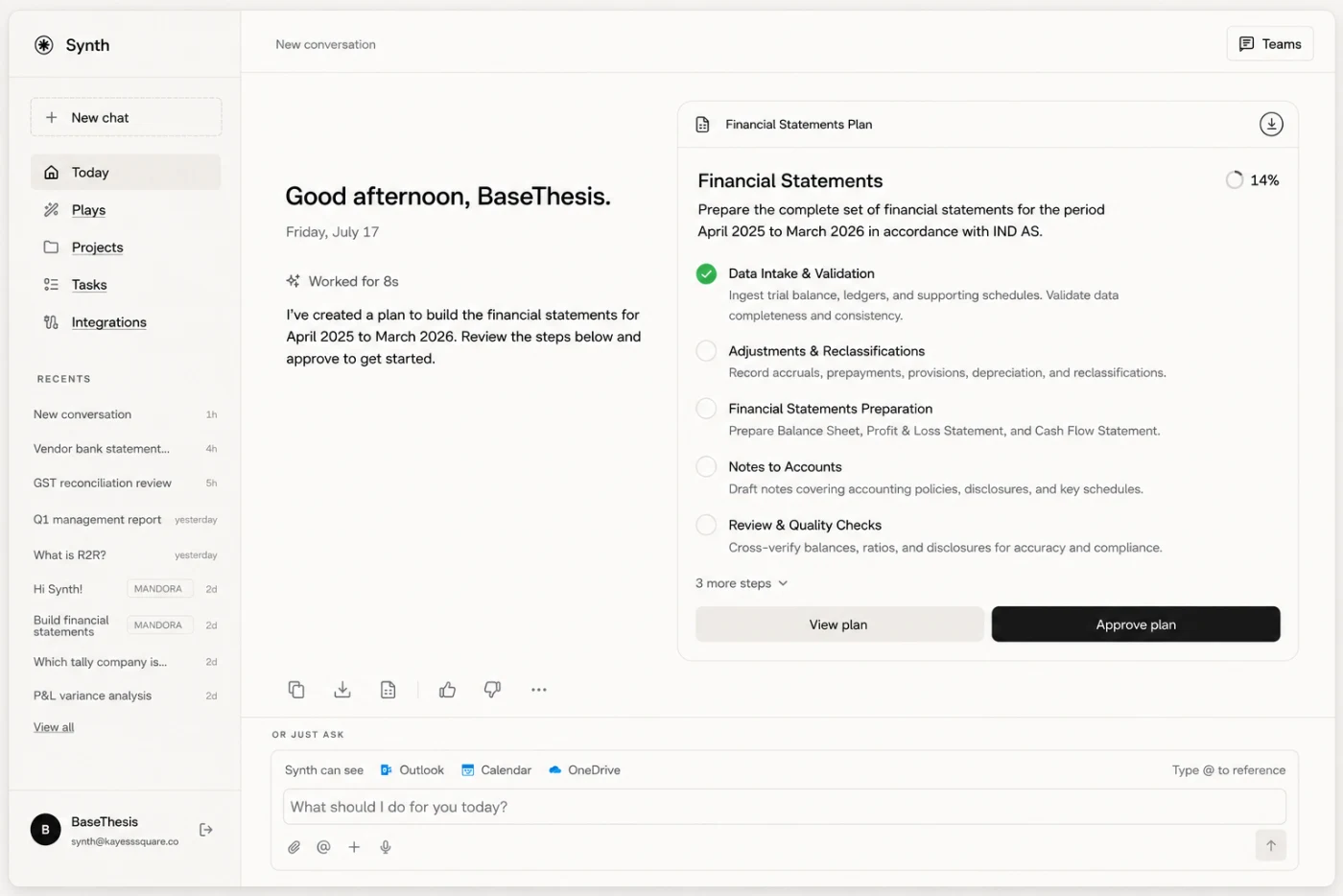
Reads Zoho Books and Tally trial balances to produce Schedule III-compliant P&L, balance sheet, and cash flow — columns, sign conventions, and logic specified explicitly against AS-3.
When a new DD engagement begins, Synth ingests the SharePoint data room: all files pass through each processing stage before any file advances to the next stage. Each document is mapped to the relevant IRL section. Gaps are flagged before the draft begins.
Confidence labeling added.
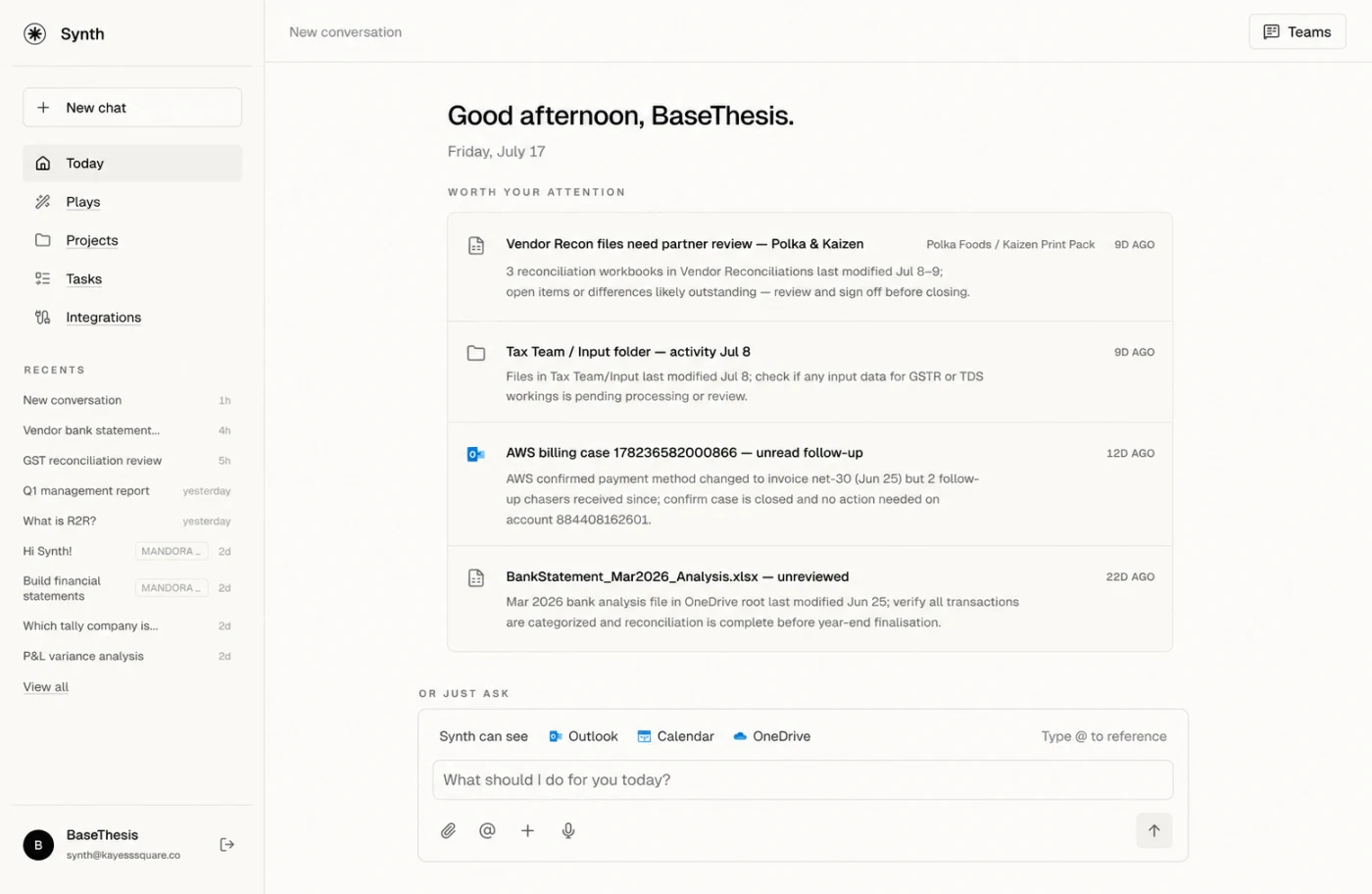
Cross-references platform settlement reports, bank statements, and ledgers simultaneously — looking into every mismatch and following up with an action point. The matching logic accounts for payments, receipts credit notes, deductions, and adjustments.
Verified Outcomes — what changed
Task-level time reductions are documented. Firm-wide engagement timing is still being collected. Underneath both, the way people actually work with Synth has shifted in three consistent ways. Pre-Synth baselines were established from the North Bound teams performing these workflows across multiple live client engagements, then compared against the same workflows after Synth was deployed in production. Benchmarks were measured over a two-month pilot timeframe from May to July 2026. The figures reported throughout this case study represent typical task-level execution times, not isolated demonstrations or best-case runs.
Three shifts, from execution to judgment.
Analysts and executives are no longer just asking Synth to explain deliverables or standards — they're treating it as a sparring partner: uploading drafts and asking it to QA the work, scan for errors, check the logic, flag what's wrong.
At department-head level, Synth takes a completed diligence summary and answers a synthesis question — what's critical, what needs raising with the client — ahead of a meeting.
Several users have built long-running session histories against specific engagements — reconciliation, due diligence, payroll consolidation — building project-specific and institutional memory.
Hallucination, scale, trust.
Invented invoice line items and reconciliation errors were both caught before reaching clients — resolved with confidence labeling, double-verification, and a final human review gate.†
Statements with 20,000+ line items, and DD workbooks past 150,000, stress-tested ingestion at scale.
Adoption wasn't a technical barrier: Many users in particular associate Synth with reduced job security, which suppresses voluntary use independent of output quality. The response runs on different tracks: individual blocker resolution via live call rather than email, hands-on sessions using each user's own real data rather than demo data, identifying true pain points of each user.
†Every extracted figure carries a confidence label — Verified, Extracted, or Estimated — that flows through to the reviewer.
Execution and judgment can be delegated. The relationship can't.
Professional services have always been built around three things: execution, judgment, and client relationships. Synth is designed to take execution off people's plates. As it builds memory across projects, clients, and firms, it also starts to support judgment — moving beyond simply extracting data to understanding what that data means in the context of a specific client's business. Client relationships, however, don't change. If anything, they become even more valuable. As Synth takes on more of the execution and analysis, the bottleneck for a firm like North Bound is no longer how many hours the team can bill. Instead, it becomes how many client relationships partners and senior advisors can meaningfully manage. That changes the growth equation. The firm can serve more clients without adding the same amount of headcount — not because it needs fewer people, but because its people spend less time on repetitive work and more time where they create the most value.
Eight months ago we asked ourselves what kind of firm we wanted to be operating in three years and worked backwards from there. The honest answer was that a lot of what our team was spending time on had nothing to do with why clients hired us. Synth helped us fix that. The firm we're running today has the same people and genuinely more capacity.
Who Synth is for
Synth is built for accounting and advisory firms where highly skilled professionals spend too much of their day collecting, reconciling, validating, and moving financial information across disconnected systems.
Rather than replacing the systems firms already use, Synth sits on top of them as an intelligence layer — connecting data, understanding context, coordinating work across tools, and helping professionals make informed decisions.
Synth isn't designed to replace accountants or tax professionals. It isn't an ERP or bookkeeping platform. It doesn't replace TallyPrime, Zoho Books, QuickBooks, or your existing software stack. It makes those systems smarter by adding a shared intelligence layer that understands data across all of them.
Put Synth to work in your firm
The same deployment, adapted to your ledger, your clients, and your filing calendar.